A strategic review of the UK government’s Zero Emissions Truck & Van Grants and Depot Charging
Scheme, and what it will take to make the money work.
The £1 billion package is the most commercially grounded intervention in commercial fleet electrification the UK has produced. The direction is right. The execution is where this transition will be won or lost.
£81kMax grant per heavy electric truck - covering up to 40% of the purchase price |
£1mMax DCS award per organisation for depot charging infrastructure |
1.4%Electric HGV market share in 2025 - the baseline this policy must move |
THE POLICY
What the Government Has Actually Done
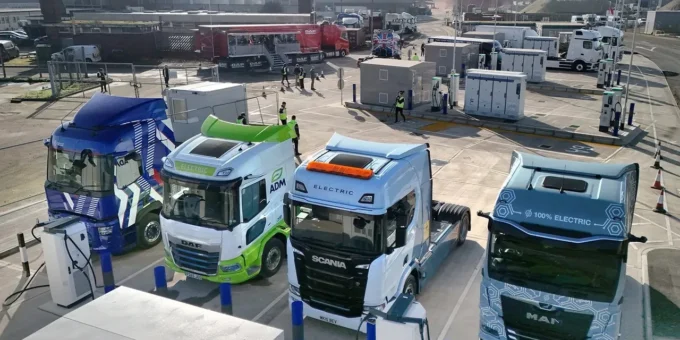
Announced on 25 March 2026, the package combines two instruments. The Zero Emissions Truck
and Van Grants offer up to £81,000 off the heaviest battery electric trucks, covering
approximately 40% of the purchase price and £5,000 off new electric vans. The Depot Charging
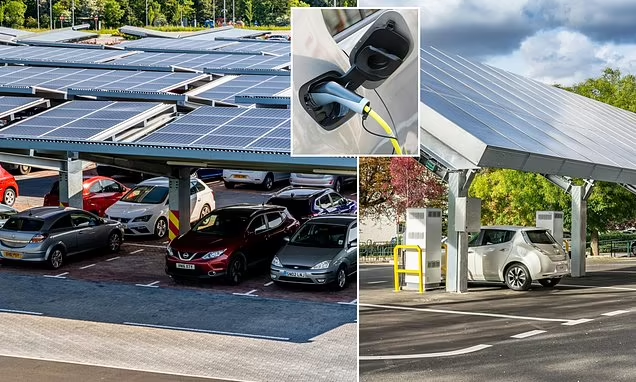
Scheme (DCS), boosted by £170 million, enables businesses and public authorities to claim up to
£1 million towards depot charging infrastructure, covering up to 70–75% of eligible costs including
chargepoints, civil works, battery energy storage, and on-site solar.
The framing is notably sharper than its predecessors. Previous HGV decarbonisation policy spoke
the language of net zero. This package speaks the language of the boardroom: protect your
margins from diesel price volatility, reduce fuel cost exposure, future-proof your operation. That
reframing will reach operators who were unmoved by environmental arguments alone.
“You can subsidise the vehicle. You can part-fund the charger. But if the grid
cannot deliver the power, neither investment deploys.”
THE CRITICAL GAP
The Infrastructure Problem Nobody Is Talking About
The Depot Charging Scheme will fund up to 70% of charger and installation costs. It will not fund the DNO grid connection upgrade that may be required before a single charger can be energised. For a depot requiring substantial power upgrades, which describes a meaningful proportion of the fleet operators this policy is targeting, that connection sits in a queue. Grid connection waits of up to 15 years have been cited for some depot operators, and six-to-seven-figure reinforcement costs sit entirely outside the grant envelope. This is not a niche problem affecting a handful of large depots. It is the execution reality for a significant share of the operators the package is designed to reach. The government has funded the visible part of the transition and left the invisible part, the grid, to the market. That is a coherent political choice. It is also precisely why a billion pounds of capital can be committed and fleet conversion can still move slowly.
WHAT IT GETS RIGHT
Four Things Worth Acknowledging
The gaps are real and should be addressed. But before cataloguing them, it is worth being clear about what this policy actually does well, because not all of it is obvious, and some of it represents a genuine improvement on the way public capital has historically been deployed in this
space.
|
It funds both sides of the investment equation simultaneously. |
|
It provides a signal to 2030 — not just to the end of the financial year. |
|
It starts where electrification is operationally most realistic. |
|
It helps the market move beyond pilots — particularly for heavier trucks. |
Four Gaps the Policy Leaves Open
| GAP | STRATEGIC CONSEQUENCE |
| Grid Connection DCS funds the charger, not the connection. DNO queue waits of up to 15 years sit entirely outside the grant envelope. |
The most expensively underutilised grant in the programme’s history if grid reform does not accompany the package. |
| Long-Haul & Hydrogen An electric-only package with no pathway for 44-tonne international freight operators for whom battery may not yet be viable. |
A technology preference that may prove commercially undeliverable at the heaviest end of the market. |
| SME Access First-come-first-served DCS window closes 30 June or when funds are exhausted. |
Large operators will absorb the majority of DCS capital before smaller hauliers have filed their applications. |
| Multi-Year Certainty Increased grant rates confirmed only to end of FY 2026/27. Fleet replacement is a 5–7 year decision cycle. |
The policy risks generating commercial interest without generating purchase orders — the wrong outcome at the wrong moment. |
|
On market reality: Zero emission HGVs represented just 1.4% of new UK truck registrations in 2025. Electric van uptake was 9.6%, barely half the 16% required by the ZEV mandate. Battery costs remain more than 30% above 2021 projections and UK industrial energy prices have risen 80% since then. The grants are necessary. They are not, on their own, sufficient. |
WHAT SHOULD HAPPEN NEXT
Three Interventions That Would Materially Improve This Policy’s Impact
|
01 |
Grid connection prioritisation. A formal DfT/Ofgem protocol giving transport depots a named fast-track category, modelled on the precedent already afforded data centres and renewable energy projects. Without this, the DCS risks funding chargers that cannot be turned on for years after installation. |
|
02 |
A multi-year funding commitment. A publicly stated minimum grant floor through FY 2028/29 would cost government almost nothing and is worth enormously to a fleet manager sitting in front of a capital allocation decision. Procurement certainty unlocks private investment that 12-month guarantees cannot. |
|
03 |
An SME ring-fence within the DCS. Reserve 30–40% of DCS capital for operators with fewer than 50 vehicles, with a dedicated application tier. First-come-first-served is a structural bias towards scale — in a sector dominated by independent hauliers, that bias will determine whether this policy accelerates a broad transition or simply subsidises operators who were going to electrify anyway. |
ABOUT SYZYGY
Syzygy is a specialist clean energy consultancy advising commercial real estate owners, asset managers, and logistics operators on solar PV, EV charging infrastructure, and energy decarbonisation strategy across the UK and Europe. We are a Certified B Corporation.
To contact our EV team please email: tony.mills@syzygyconsulting.eu